
Blog
What Is the Trade-In Value of Medical Equipment, and Why Isn't It an Appraisal?
A dealer's trade-in credit toward new medical equipment is a commercial offer, not an independent valuation, and the two numbers can be far apart. This guide explains what drives a trade-in quote and when a hospital, clinic, or donor should insist on a real appraisal instead.
A hospital replacing an imaging system, a dental practice upgrading its intraoral scanner, or a lab swapping out an analyzer will almost always get a trade-in quote from the vendor selling the new unit. That number can look generous or insultingly low, and either way, it is not the same thing as an appraised value. Understanding what a trade-in credit actually measures, and when it is not good enough, protects your deduction, your sale price, or your negotiating position.
What Is Trade-In Value in Medical Equipment?
Trade-in value is the credit a manufacturer, dealer, or equipment broker offers for a specific unit when it is surrendered as part of buying a replacement. It is a transaction-specific offer, not a generally recognized valuation conclusion. The amount reflects that buyer's own resale expectations, refurbishment costs, shipping and logistics, warranty exposure, and above all, its incentive to close the sale of the new equipment.
The exact quote depends on practical details: make, model, and serial number; age, operating hours, and service history; software version and regulatory status; whether replacement parts are still available; and whether the unit is installed, deinstalled, or ready to ship. Two dealers looking at the same analyzer can arrive at very different trade-in numbers, because each is pricing the deal that benefits their own resale channel, not answering a neutral question about market value.
That is the core distinction. A trade-in offer is evidence of one negotiated exchange with a strategic counterparty who has a financial stake in the outcome.
How Trade-In Value Differs From Fair Market Value and Liquidation Value
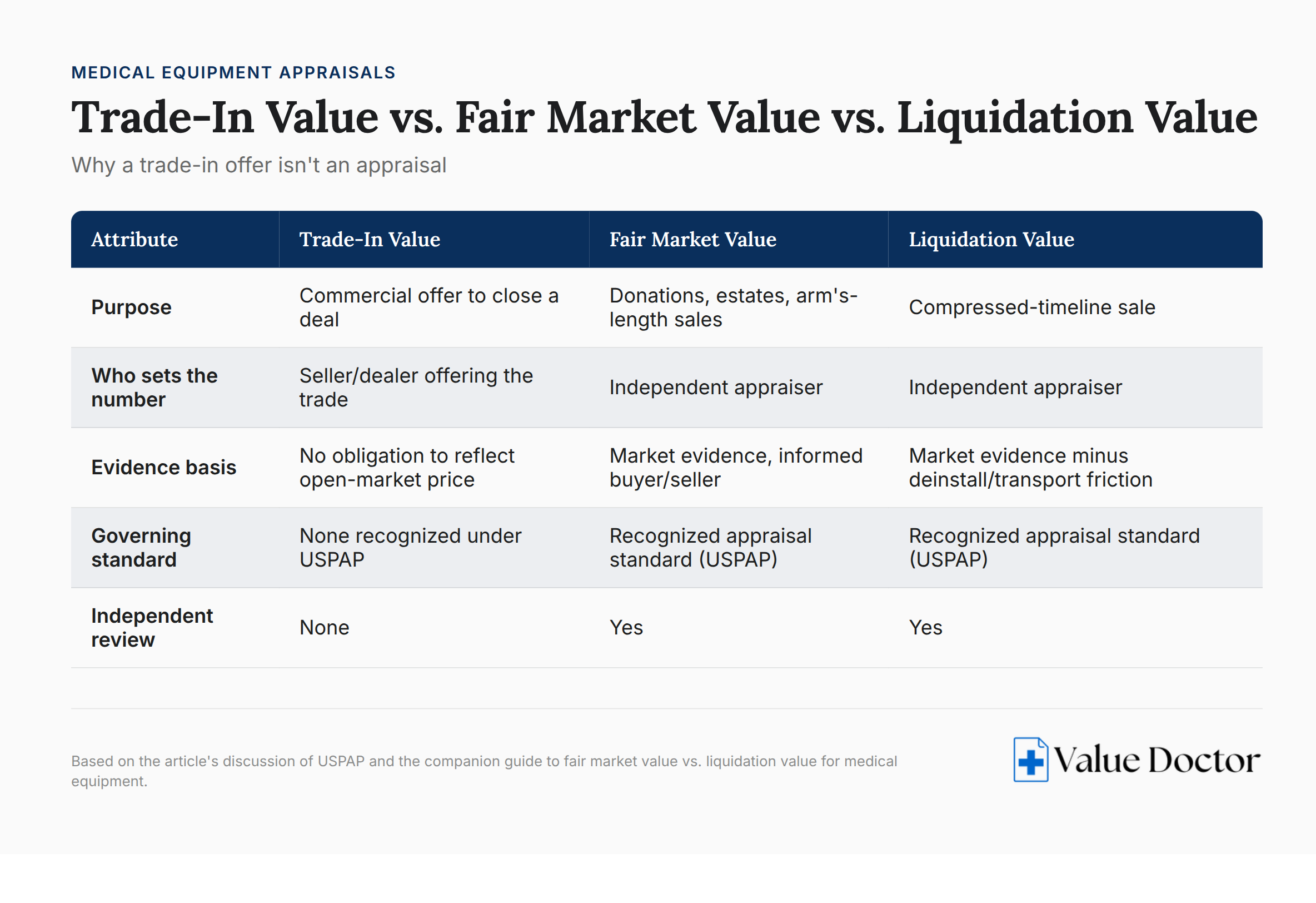
An appraisal is an opinion of value developed for a stated purpose, effective date, and standard of value, supported by market evidence and a defensible methodology. Trade-in value is none of those things: it has no fixed standard, no independent reviewer, and no obligation to reflect what an unrelated buyer would pay in the open market.
Our guide to fair market value versus liquidation value for medical equipment covers those two standards in depth, including when each applies and how they are calculated. The short version: fair market value assumes an informed buyer and seller, neither under compulsion, and is the standard used for donations, estates, and arm's-length sales. Liquidation value assumes a compressed timeline and the friction of deinstallation and transport, and tends to run lower. Trade-in value is neither. It is not a standard of value recognized under the Uniform Standards of Professional Appraisal Practice (USPAP) at all; it is a commercial offer, and an appraiser asked to look at a trade-in situation needs to be explicit about which premise, if any, they are actually reporting against.
Why a Trade-In Offer Can Run Below Fair Market Value
A trade-in quote can land well below a unit's fair market value, and the reasons are structural, not personal. The vendor offering the credit is also setting the price of the replacement equipment, so the two numbers move together. A dealer can quietly discount the new system's list price while holding the trade-in credit low, or do the reverse, and either way the headline trade-in figure tells you very little on its own.
Other common drivers:
- Limited resale channel for that specific modality. A dealer who does not typically resell a given brand or configuration has nowhere profitable to place the used unit, so the credit reflects salvage value more than market value.
- Refurbishment and recertification costs. The buyer has to account for inspection, parts, calibration, and compliance work before the unit can be resold, and those costs come straight out of the offer.
- Bundled economics. The credit may be baked into a package price that also includes installation, training, financing terms, or an extended warranty on the new equipment, making the trade-in number impossible to evaluate in isolation.
- No competitive pressure. Unlike an open-market sale, the seller usually is not soliciting competing trade-in bids, so there is no market test on the number offered.
Example: A clinic is quoted $18,000 for a replacement system and told the trade-in on its old unit is worth $2,000, for a net cost of $16,000. The same vendor quotes $19,500 with no trade-in at all. The real trade-in credit in that deal is only $1,500, not the $2,000 headline figure, because the vendor raised the baseline price to absorb part of the allowance. Comparing net cost with and without the trade-in, not the trade-in number by itself, is the only way to see what is actually being offered.
When Trade-In Value Is a Reasonable Choice
A trade-in credit can be a perfectly sensible basis for a decision when the stakes are purely operational:
- The equipment is being upgraded as a routine replacement cycle and there is no tax filing, lender covenant, insurance claim, or legal proceeding attached to the transaction.
- The practice or facility is comfortable accepting whatever net cost the vendor quotes after comparing prices with and without the credit.
- The unit has limited remaining useful life and the administrative cost of an independent valuation would exceed any likely benefit.
In these cases, a trade-in quote is simply a business negotiation, and treating it as anything more formal would be unnecessary overhead.
When You Should Insist on an Independent Appraisal Instead
A trade-in offer stops being good enough the moment the number has to answer to someone other than the two parties in the room. The most common situations:
- Charitable donation of retired equipment. The IRS generally requires a qualified appraisal when the claimed deduction for an item, or a group of similar items in aggregate, exceeds $5,000, per the IRS Form 8283 instructions. Medical equipment of the same generic type is aggregated for this purpose, an issue a federal court addressed directly when it examined the qualified-appraisal requirement for donated medical equipment in a reported tax decision. If the claimed deduction exceeds $500,000, IRS Publication 561 requires the qualified appraisal to be attached to the return. A dealer's trade-in quote, however generous, does not satisfy this requirement. Our medical equipment appraisal for charitable donation service is built specifically around that substantiation standard.
- Estate settlement or practice sale. A trade-in number reflects what one vendor will pay toward a replacement purchase, not what a group of heirs, partners, or a buyer's counsel needs to see as a defensible, arm's-length value.
- Insurance claims. An insurer evaluating a loss needs a documented, standards-based opinion of value, not a self-interested quote from the party selling the replacement.
- Litigation or a dispute over an unusually low quote. When a trade-in offer looks out of line with what comparable equipment is fetching, a formal appraisal gives you independent, defensible evidence rather than a single data point from an interested party.
- Lender or audit requirements. Collateral valuations and financial reporting generally call for a documented opinion of value under a stated methodology, not a vendor's internal pricing.
This is true whether the equipment sits in a hospital imaging suite, a lab, a dental operatory, or an optometry practice. The appraiser has no stake in whether you buy the new machine, which is exactly the point: the opinion is independent of the sale.
What to Request From a Dealer Before Accepting a Trade-In Offer
If you decide a trade-in credit is the right path for your situation, treat the quote the way you would any other business offer and get the details in writing before you commit.
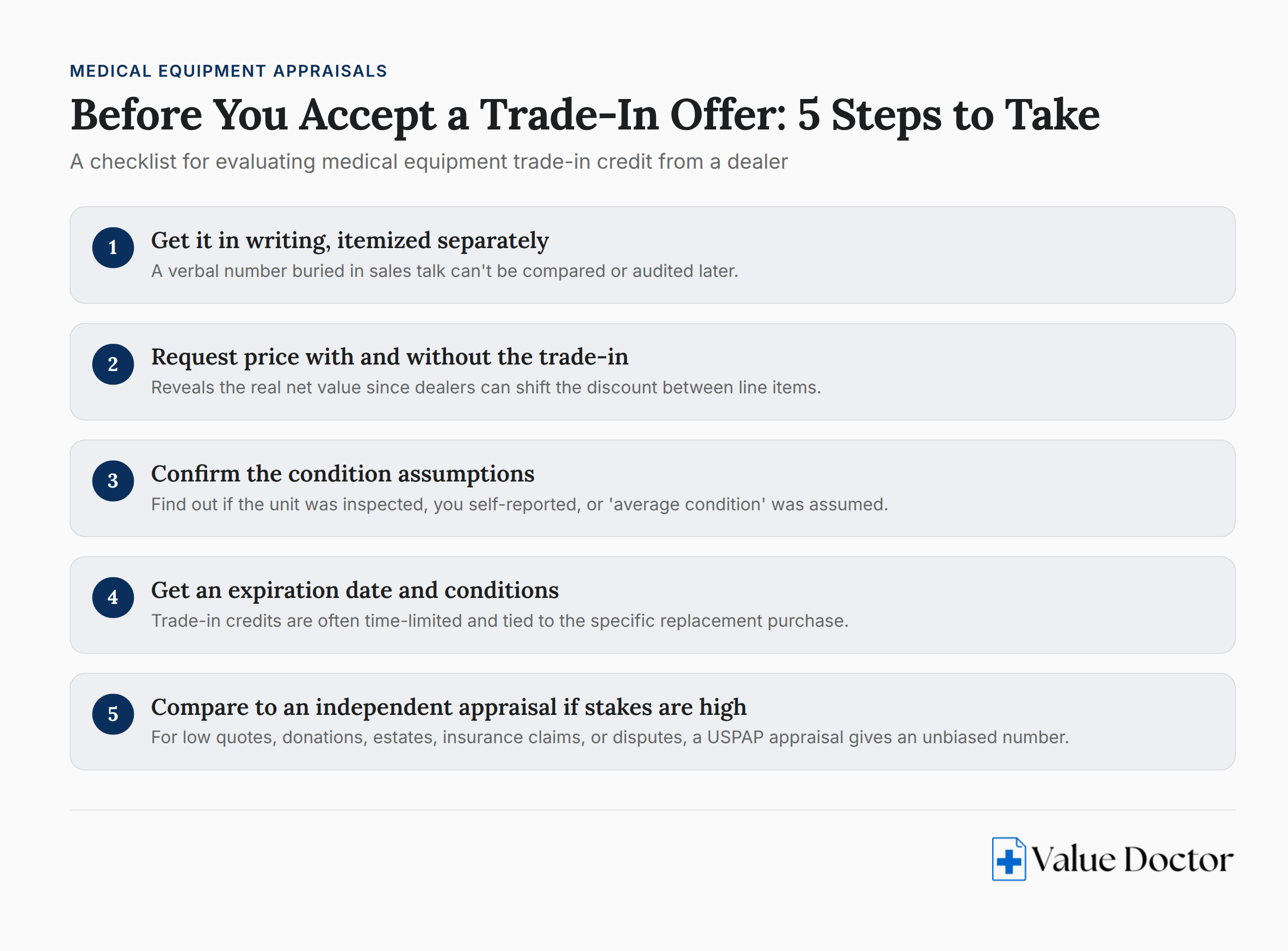
- Get the offer in writing, itemized separately from the new equipment price. A verbal number buried in a sales conversation cannot be compared or audited later.
- Ask for the replacement equipment's price with and without the trade-in. This is the only way to see the real net value of the credit, since vendors can shift the discount between the two line items.
- Confirm the condition assumptions behind the quote. Find out whether the dealer inspected the unit, relied on your own representations, or assumed average condition without inspection.
- Get an expiration date and any conditions on the offer. Trade-in credits are frequently time-limited to the specific replacement purchase and can change if the deal timeline shifts.
- Compare against an independent opinion of value when the stakes justify it. If the trade-in quote looks low, or the transaction touches a donation, estate, insurance claim, or dispute, a formal appraisal prepared in accordance with USPAP gives you a number nobody on the other side of the table had a hand in setting.
Protecting the Number Before You Sign
A trade-in quote answers a narrow question: what will this particular vendor credit you toward this particular replacement purchase. It was never designed to answer the broader question of what the equipment is actually worth, and treating it as an appraisal, whether for a tax filing, an estate, an insurance claim, or simply peace of mind, puts the seller at a disadvantage. Facilities replacing hospital-grade systems, in particular, often have the most to lose from accepting a number set entirely by the party selling them the new equipment; our hospital equipment appraisal service exists for exactly that gap between a vendor's offer and an independent opinion of value.
When the decision is routine and low-stakes, a trade-in credit is a fine shortcut. When money, tax treatment, or a legal outcome depends on the number, get an independent, standards-based appraisal before you sign.
This article is provided for general informational purposes only and does not constitute legal, tax, or financial advice. Readers should consult a qualified attorney or CPA regarding their specific circumstances.